

If you run money through your own company, there’s a good chance you’ve got one — even if nobody’s ever called it that.
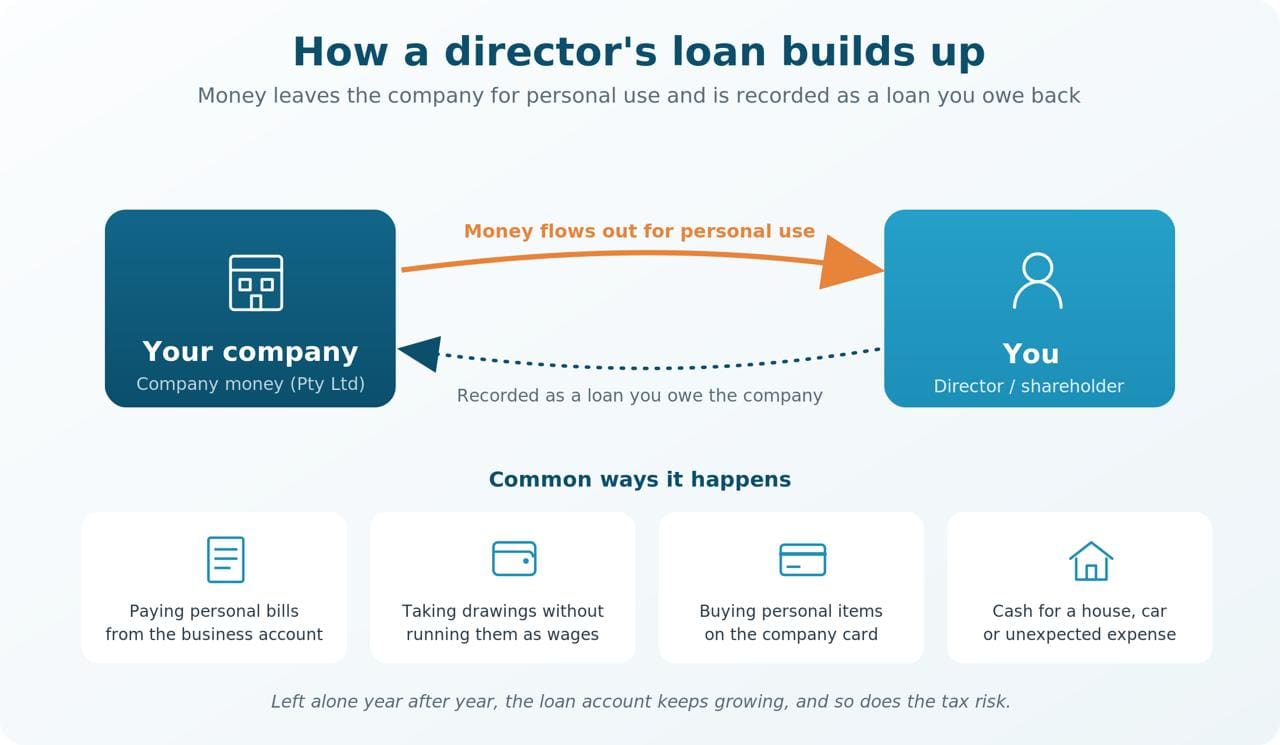
Here’s a situation we see all the time. You own a company. Over the years, you’ve paid the odd personal bill out of the business account, taken some cash when it was tight at home, or bought something personal on the company card. None of it felt like a big deal at the time. But on the books, every one of those transactions is money the company has lent you – a “director’s loan.”
It’s completely normal, and it’s not a problem in itself. It becomes a problem when it’s left to build up and never dealt with properly. This post explains what a director’s loan actually is, why it matters, and how we help you sort it out.
What is a director’s loan?
A director’s loan (you might also hear it called a shareholder loan or a “Division 7A loan”) is simply money that’s come out of your company for your personal benefit, rather than being paid to you as wages or a dividend. Because a company is a separate legal entity, that money isn’t just “yours” to take – the tax rules treat it as a loan you owe back to the company.
Most of the time it isn’t a deliberate decision. It builds up quietly:
Why it matters
The tax rules (specifically Division 7A) say that if you borrow from your own company and don’t deal with it the right way by the time the company’s tax return is due, the ATO can treat the loan as a dividend paid to you – and tax you on it. The sting is that it’s usually an unfranked dividend, meaning you get no credit for the tax the company has already paid. You can end up paying tax on money you spent years ago.
There’s also a simpler, human problem. If the loan account is allowed to grow for years, it can reach a point where you genuinely can’t repay it – the money went into a home, a car, or day-to-day living, and it’s long gone. The bigger it gets, the harder and more expensive it is to unwind.
The risks at a glance
| The risk | What it means for you | How we deal with it |
| A surprise tax bill | If the loan isn’t dealt with in time, the ATO can treat it as an unfranked dividend – taxed in your name, with no credit for tax the company already paid. | We declare a fully franked dividend so you get credit for company tax already paid. |
| It keeps growing | Small drawings each year quietly stack up into a big balance you’ve spent and can’t easily hand back. | We map it early and use trust distributions or wages to chip it down before year-end. |
| You can’t repay it | The money’s often gone into a house, a car or living costs, so repaying the company in cash isn’t realistic. | We put it on a complying loan agreement (7 or 25 years) with manageable set repayments. |
| Interest you didn’t plan for | Formal loans must charge an ATO benchmark rate each year, and ignoring it adds up. | We build the repayments and interest into your plan so there are no surprises. |
| ATO attention | A large, untreated loan account is a classic red flag in an ATO review. | We keep the paperwork clean and lodged, so your position stands up to scrutiny. |
How QC Accountants sorts it out
The good news: a director’s loan is very fixable, and there’s rarely just one way to do it. Our job is to look at your entire structure (company, trust, wages, profits) and pick the combination that minimises the tax on the loan. Here are the main levers we use:
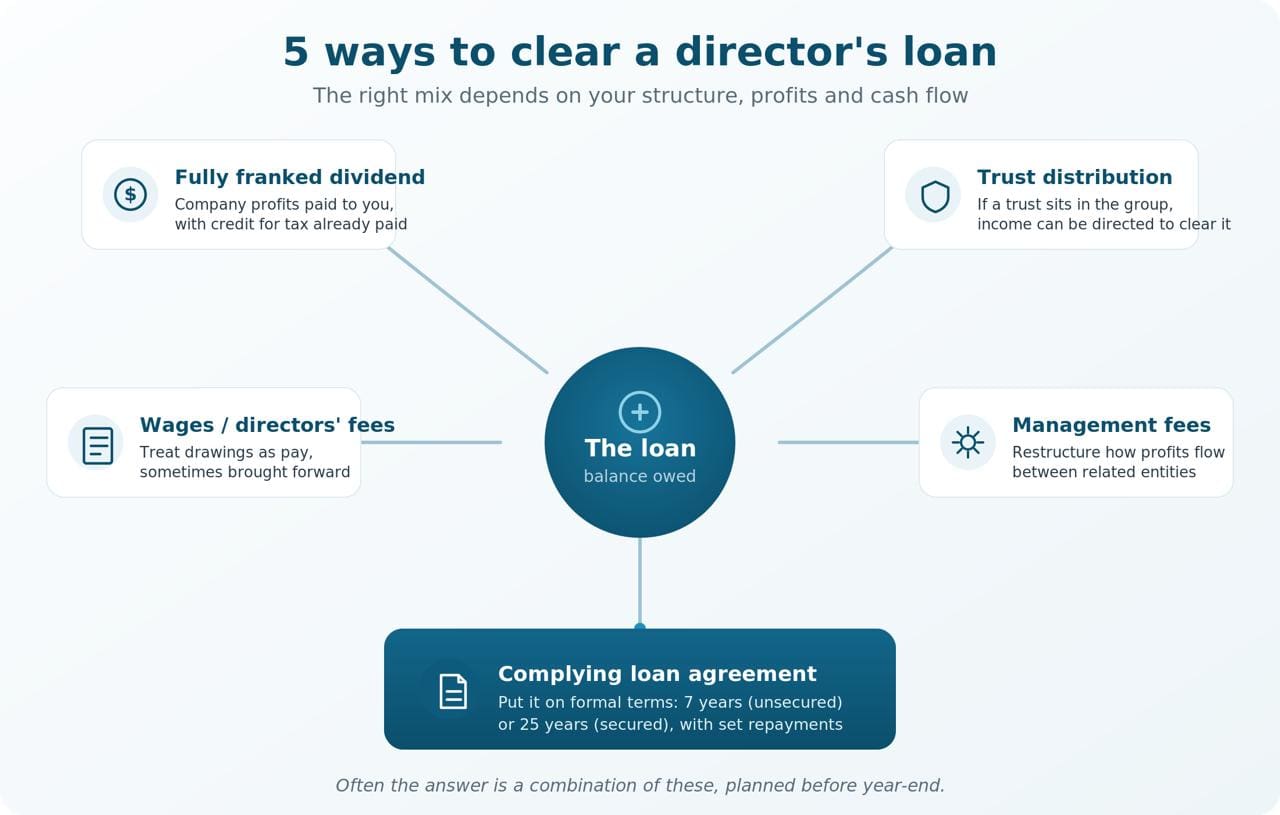
In plain terms, that means we might: declare a fully franked dividend so you get credit for company tax already paid; direct a trust distribution to clear the balance where a trust sits in your group; treat drawings as wages or directors’ fees (sometimes brought forward as a prepayment); use management fees to change how profits flow between related entities; or put the loan onto a formal complying agreement (seven years if it’s unsecured, or twenty-five years if it’s secured against property) with set repayments and interest built into your plan.
The key is timing. Most of these options must be in place before your company’s tax return is lodged, so the earlier we review them, the more choices you have and the less it will cost. Leave it too long and the options narrow.