

ATO payment plans have always been a practical way for Gold Coast business owners to manage tax obligations without putting pressure on cash flow. For many years, the interest charged on those payment plans was tax deductible, which helped soften the cost of carrying tax debt and made payment plans a manageable option.
That is no longer the case. From 1 July 2025, interest paid to the ATO is no longer tax deductible. This change has already taken effect, and businesses are now absorbing the full cost of ATO interest with no tax offset. For some business owners, this shift will increase annual expenses by thousands of dollars.
Understanding how the change affects your business and what options you have moving forward is essential. This article explains what has changed, why it matters, and how refinancing your ATO debt may be a more tax‑effective alternative now that the deduction has been removed.
What the ATO Interest Change Means
The ATO charges interest on overdue tax and on payment plans. This interest is known as the general interest charge or the shortfall interest charge. Before 1 July 2025, businesses could claim a tax deduction for this interest. The deduction reduced taxable income and lowered the effective cost of carrying ATO debt.
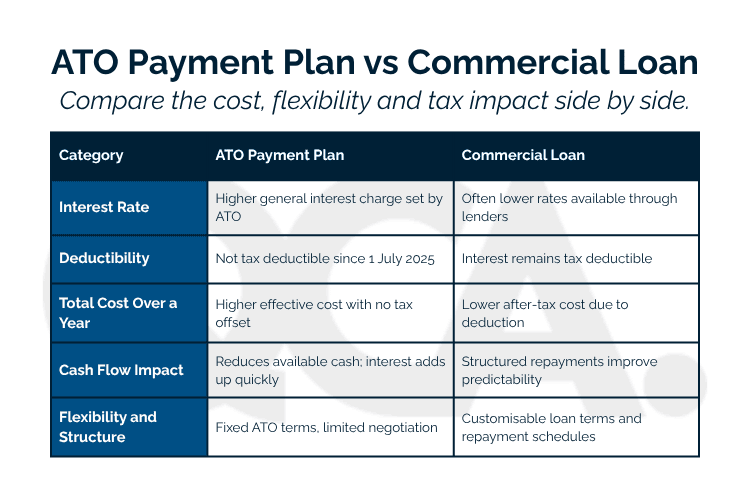
The deduction has now been removed. Interest paid to the ATO is no longer deductible, regardless of whether the debt relates to income tax, GST, PAYG withholding or any other tax type. The interest rate itself has not changed, but the tax benefit attached to it has disappeared. Businesses now absorb the full cost of ATO interest with no tax relief.
This affects all business structures. Companies, sole traders, partnerships and trusts no longer receive a deduction for ATO interest. Any business using an ATO payment plan or carrying overdue tax is impacted.
Why the Change Could Cost You Thousands
The removal of the deduction increases the real cost of ATO interest. The ATO’s interest rate is already higher than many commercial lending rates. Without the deduction, the gap between ATO interest and commercial loan interest becomes even more significant.
ATO interest is designed to encourage timely payment. It is not intended to be a low‑cost financing option. When the deduction existed, businesses could offset part of the cost. Now that the deduction has been removed, the interest becomes a direct expense with no tax benefit.
The financial impact depends on the size of the debt and how long it is carried. A small debt paid off quickly may not create a high cost. A larger debt carried over several months or years can become expensive. The longer the debt remains unpaid, the more interest accumulates, and the more the removal of the deduction matters.
Businesses with tight cash flow may feel the impact more strongly. Without the deduction, interest becomes a direct hit to profitability. Over time, this can affect investment decisions, staffing and the ability to grow.
How Existing ATO Payment Plans Are Affected
The rule change applies to interest paid on or after 1 July 2025. If you had an existing payment plan before that date, any interest paid prior to 1 July 2025 remained deductible. Interest paid after that date is not deductible, even if the payment plan was set up earlier.
This means businesses with long‑term payment plans have already seen the cost increase. If you currently have an ATO payment plan, the interest you are paying now is fully non‑deductible. For many businesses, this has changed the cost‑benefit equation of staying with an ATO payment plan.
Payment plans are still available, but they are now more expensive. The ATO continues to offer them, but the financial impact is greater than it was before the rule change.
Why Refinancing Your ATO Debt Can Help
The removal of the deduction does not affect commercial lending. Interest paid on commercial loans remains tax deductible. This creates an opportunity for businesses to reduce the after‑tax cost of managing ATO debt.
Replacing an ATO payment plan with a commercial loan gives businesses a different way to manage tax debt. Under this approach, the loan pays out the outstanding ATO balance, and repayments shift from the ATO to the lender. This structure restores the tax benefit that no longer applies to ATO interest, because commercial loan interest remains deductible. For many businesses, this alone can make a noticeable difference to the overall cost of carrying tax debt.
Another advantage is the potential to access lower interest rates. Commercial lenders often offer rates that sit well below the ATO’s general interest charge, which means the cost of borrowing can drop significantly. When these lower rates are combined with the ability to claim a deduction, the financial benefit becomes even more substantial. Over time, the difference between ATO interest and commercial loan interest can add up to meaningful savings.
Not every business will be suited to refinancing, and it is important to consider individual circumstances before making a decision. Factors such as credit history, cash flow stability and the ability to meet structured loan repayments all play a role. Even so, many businesses are finding that refinancing is now a more tax‑effective and financially sensible alternative to staying on an ATO payment plan, especially since the deduction for ATO interest has been removed.
The process is straightforward. A broker assesses your situation, identifies suitable lenders and helps you secure a loan that fits your needs. Once approved, the loan pays out the ATO debt, and you begin repaying the lender instead of the ATO.
When Refinancing Makes Sense
Refinancing is worth considering if you have a significant ATO debt or if you expect to carry the debt for more than a few months. The longer the repayment period, the more interest accumulates, and the more valuable the deduction becomes.
It is also worth considering if your business has stable cash flow and can comfortably meet loan repayments. Commercial loans often have structured repayment schedules, which can help with budgeting and planning.
Businesses that want to reduce the cost of debt or improve cash flow may benefit from refinancing. It can also help businesses avoid the higher interest rates charged by the ATO.
If you are unsure whether refinancing is right for you, a broker can help you compare the cost of staying with the ATO versus moving to a commercial lender. The comparison can highlight the potential savings and help you make an informed decision.
Working With Brokers Who Understand Tax Debt
Refinancing ATO debt requires a lender who understands the nature of tax obligations. Not all lenders offer products designed for this purpose. Working with a broker who specialises in tax debt refinancing can make the process easier and more effective.
QC Accountants works with a network of brokers who understand how ATO debt works and how to structure loans that suit business needs. These brokers can help you explore your options, compare lenders and secure a loan that fits your financial position.
The brokers we work with understand the urgency of tax debt and the importance of managing cash flow. They can help you move quickly and ensure the refinancing process is smooth and efficient.
A Practical Way to Move Forward
The removal of the deduction for ATO interest is a significant change. It increases the cost of carrying tax debt and affects businesses that rely on payment plans. Understanding the impact now will help you make informed decisions about how to manage your tax obligations.
A practical first step is to review your current ATO balance and any existing payment plans. Consider how much interest you are likely to pay under the new rules. If the cost is high, refinancing may be worth exploring.
You can also review your cash flow and financial position to determine whether a commercial loan is a suitable option. If refinancing could reduce your costs, improve your cash flow or help you manage debt more effectively, it is worth considering.
QC Accountants helps Gold Coast businesses stay ahead of tax changes and make informed decisions. If you want to explore refinancing options or understand how the ATO interest change affects your business, book a chat or call us on (07) 5593 6060.
This is general information only, not financial or legal advice. Rules and thresholds change, so check current requirements with the ATO or speak to us before acting.