

Work vehicles are a common source of confusion for Gold Coast business owners. Utes, vans and electric vehicles all sit under different ATO rules, and the way the vehicle is built often matters more than how you use it. The one tonne rule is the dividing line that determines whether your vehicle is treated as a commercial vehicle or as a car for fringe benefits tax. Once you understand how the one tonne rule works, the rest becomes practical.
Many business owners assume their ute or van is automatically exempt from fringe benefits tax because it looks like a work vehicle. The ATO does not rely on appearance. It relies on carrying capacity. That single detail changes how the vehicle is taxed and whether private use becomes an issue.
What the One Tonne Rule Actually Means
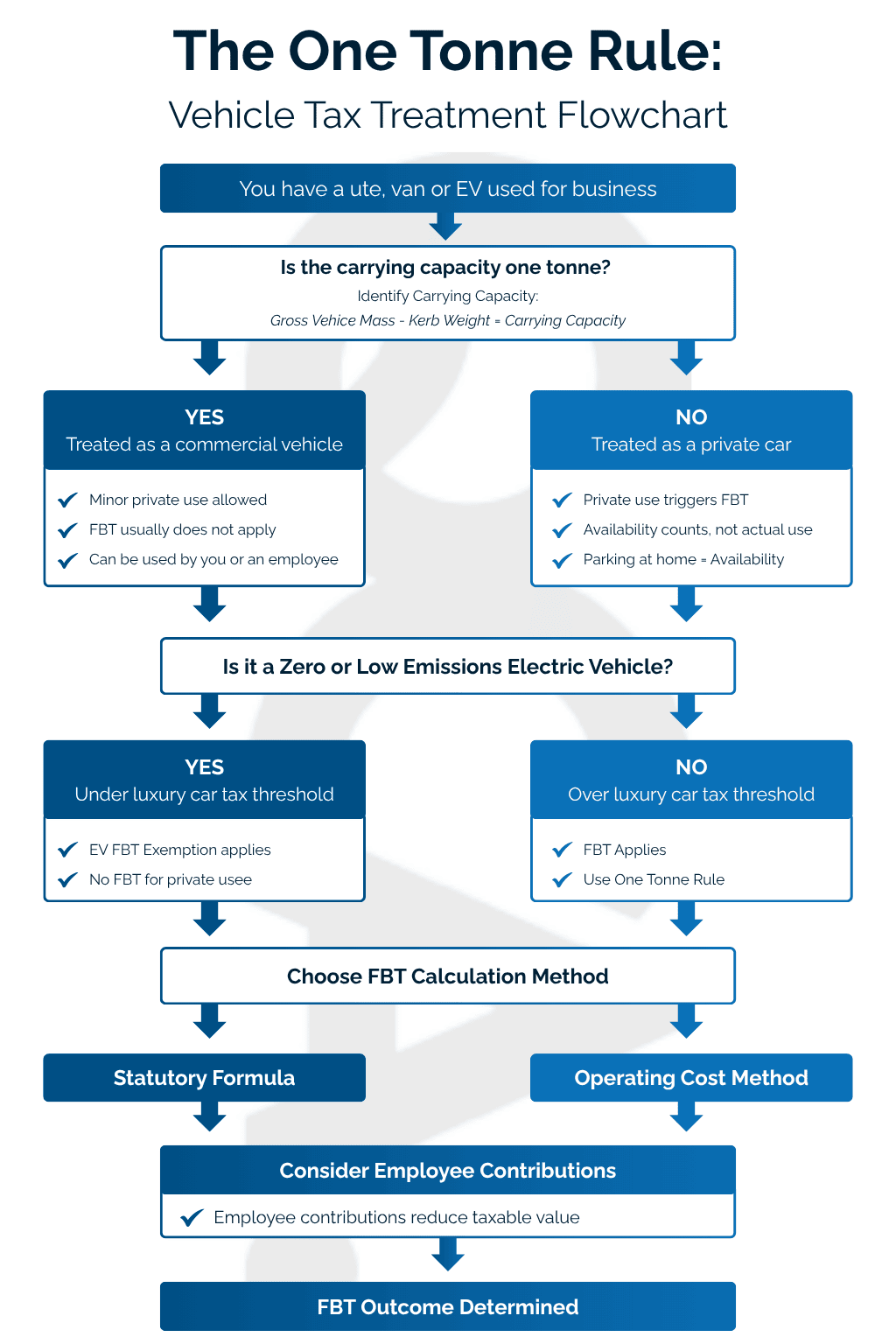
The one tonne rule is based on carrying capacity. A vehicle with a carrying capacity of more than one tonne is generally treated as a commercial vehicle. The ATO accepts that these vehicles are designed for work and are usually used that way. When your vehicle meets the one tonne rule, private use is treated differently and fringe benefits tax often does not apply.
Carrying capacity is the difference between the gross vehicle mass and the kerb weight. Gross vehicle mass is the maximum weight the vehicle can legally carry, including passengers, fuel and cargo. Kerb weight is the weight of the vehicle with a full tank of fuel and no passengers or cargo. The difference between the two is the carrying capacity.
This calculation catches many business owners by surprise. Dual cab utes often fall under the threshold because the passenger cabin reduces the available load. A vehicle that looks like a workhorse can still be treated as a car for tax purposes.
Why the One Tonne Rule Matters
The one tonne rule determines whether your vehicle is exempt from fringe benefits tax or whether you need to calculate the taxable value of private use. When your vehicle meets the one tonne rule, the ATO generally accepts limited private use. Driving between home and work, stopping at the shops on the way home or using the vehicle for minor personal errands is usually fine.
When your vehicle does not meet the one tonne rule, the ATO treats it as a car. This means fringe benefits tax applies when the vehicle is available for private use. Availability is what matters, not actual use. Parking the vehicle at home overnight counts as availability. Even when private use is rare, fringe benefits tax still applies unless the vehicle meets the one tonne rule or qualifies for an exemption.
This is why the one tonne rule is so important. It determines whether your vehicle sits in the commercial category or the car category. The difference between those two categories can be significant.
How the One Tonne Rule Applies to Utes And Vans
Utes and vans are the vehicles most affected by the one tonne rule. Single cab utes often meet the threshold because they have a larger tray and fewer passenger seats. Dual cab utes often fall under the threshold because the cabin reduces the available load. Vans vary widely depending on their design and intended use.
You can check your vehicle’s carrying capacity by looking at the manufacturer’s specifications. The gross vehicle mass and kerb weight are usually listed on the compliance plate or in the owner’s manual. Once you have those numbers, the calculation is straightforward.
When your ute or van meets the one tonne rule, the ATO accepts that the vehicle is designed for work. You can provide the vehicle to an employee or use it yourself without triggering fringe benefits tax, as long as private use stays minor and incidental. When your vehicle does not meet the one tonne rule, you need to consider fringe benefits tax and how private use is handled.
Electric Vehicles and the One Tonne Rule
Electric vehicles sit under a different set of rules. The one tonne rule still applies to EVs that are designed as commercial vehicles, but most EVs fall into the passenger vehicle category. This means fringe benefits tax applies unless the EV qualifies for the current exemption.
How the EV Exemption Works
The exemption is tied to the federal Electric Car Discount. It uses the Luxury Car Tax threshold for fuel‑efficient vehicles. For the 2026-27 financial year, the threshold is $91,661. An eligible EV that is priced at or below this amount qualifies for a full fringe benefits tax exemption.
Upcoming Threshold Changes
The rules will tighten from April 1, 2027. The full exemption will only apply to EVs that cost $75,000 or less. Vehicles priced between $75,000 and the Luxury Car Tax threshold will receive a partial 25% fringe benefits tax discount. From April 1, 2029, all eligible EVs below the Luxury Car Tax threshold will receive a flat 25% discount.
These changes mean the exemption will continue, but the benefit will reduce over time. Larger or more expensive EVs often sit above the threshold and do not qualify.
EVs That Still Use the One Tonne Rule
Some electric vans and electric utes meet the one tonne rule and are treated as commercial vehicles. These vehicles follow the same rules as their petrol or diesel equivalents. When an EV meets the one tonne rule, private use is treated as minor and incidental, and fringe benefits tax generally does not apply.
FBT When Your Vehicle Does not Meet the One Tonne Rule
Fringe benefits tax applies when an employee, including you as a director, uses a business vehicle privately. When your vehicle does not meet the one tonne rule, the ATO treats it as a car and fringe benefits tax applies based on the taxable value of private use.
There are two ways to calculate the taxable value. The statutory formula applies a fixed percentage to the vehicle’s cost. The operating cost method uses actual running costs and a business percentage. The operating cost method requires a valid logbook. Without a logbook, you cannot use the operating cost method.
Many business owners assume fringe benefits tax will not apply because private use is minimal. The ATO focuses on availability. Parking the vehicle at home overnight counts as availability. Even when private use is rare, fringe benefits tax still applies unless the vehicle meets the one tonne rule or qualifies for the EV exemption.
Employee Contributions and How They Reduce FBT
Employee contributions are a practical way to reduce fringe benefits tax when your vehicle does not meet the one tonne rule. An employee contribution is a payment made by the employee to the employer to cover private use. The contribution reduces the taxable value dollar for dollar.
Employee contributions can be paid through payroll or directly to the business. They need to be documented and included in your fringe benefits tax calculations. Many businesses use employee contributions to keep fringe benefits tax manageable without changing how the vehicle is used.
When your vehicle meets the one tonne rule or qualifies for the EV exemption, employee contributions are usually not needed. When your vehicle does not meet the threshold, contributions can be a useful tool.
Common Mistakes Gold Coast Business Owners Make with the One Tonne Rule
The most common mistake is assuming a ute is exempt from fringe benefits tax because it looks like a work vehicle. The ATO does not rely on appearance. It relies on carrying capacity. A dual cab ute with a lower load capacity can trigger fringe benefits tax even when it is used mostly for work.
Another mistake is assuming electric vehicles are automatically exempt. The exemption only applies to eligible vehicles under the luxury car tax threshold. Many popular EVs sit above that threshold and do not qualify.
Some business owners also forget that availability triggers fringe benefits tax. Parking the vehicle at home overnight counts as availability. Even when private use is minimal, fringe benefits tax still applies unless the vehicle meets the one tonne rule or qualifies for the EV exemption.
A Practical Way to Move Forward
You can get clarity quickly by confirming your vehicle’s carrying capacity, checking whether your EV sits under the luxury car tax threshold and reviewing how your vehicle is used. Once you know where your vehicle sits under the one tonne rule, the rest becomes straightforward.
At QC Accountants, we help Gold Coast businesses stay on top of vehicle tax rules and fringe benefits tax. If you want help reviewing your ute, van or EV position, book a chat or call (07) 5593 6060.
Notice: This is general information only, not financial or legal advice. Rules and thresholds change, so check current requirements with the ATO or speak to us before acting.