
Payment scams are now one of the fastest-growing threats to Australian businesses. They affect every industry, from ecommerce stores and NDIS providers to construction firms paying subcontractors. October is Cyber Security Month, making it a timely time to strengthen your processes, but the risk doesn’t disappear once the month ends. Scammers target businesses year-round, and the most damaging scams often look exactly like the invoices, emails and payment requests you receive every day.
This article explains how payment scams work, why they are so hard to detect and the practical steps your business can take to stop them before they cost you money. It also explains how these habits connect to your bookkeeping processes and why consistent verification is one of the most effective defences.
Why Payment Scams Are So Hard to Detect
Payment scams succeed because scammers mimic the exact communication patterns your business already trusts. They copy logos, ABNs and email signatures, and they often insert themselves into existing email threads so the message appears to come from the same address you have been communicating with. Scamwatch notes that scammers may hack a business’s email system or impersonate the address by changing as little as one letter, making the email appear legitimate at first glance.
For mid-sized businesses, this is particularly dangerous. You deal with multiple suppliers, subcontractors, clients and service providers. You receive invoices daily and approve payments quickly to keep operations moving. Scammers rely on this pace. They know that a realistic invoice arriving at the right moment is unlikely to be questioned.
The scammer’s goal is simple. They want you to pay a real invoice to the wrong bank account. Once the money is transferred, it is extremely difficult to recover. The real supplier then contacts you to request payment, and you discover the funds you sent went to a fraudulent account instead.
How Payment Scams Typically Work
Although scammers use different techniques, most payment scams follow a predictable pattern. Understanding this pattern helps you recognise the warning signs early.
Fake Invoices With Changed Bank Details
This is the most common payment scam. You receive an invoice from a supplier you are expecting to hear from. The invoice looks genuine, but the bank details have been changed. Scamwatch confirms that scammers often modify the BSB and account number on an otherwise legitimate invoice, directing your payment to their own account.
Compromised or Impersonated Email Accounts
The ACCC reports that scammers may access a business’s email account or impersonate the address by changing a single character, making the email appear legitimate. Because the email appears in the same thread as previous correspondence, staff assume it is safe.
Supplier Detail Changes Without Notice
Scamwatch highlights that unexpected changes to supplier payment details are a key warning sign of a payment scam. Scammers rely on the assumption that staff will accept the change without verification.
Impersonation of Staff or Directors
Some scammers impersonate internal staff, including accounts team members or directors, requesting urgent payments or changes to bank details. These messages often appear during busy periods when staff are less likely to question unusual requests.
Industries Most Commonly Targeted
Payment scams affect every industry, but some sectors lose more because they regularly process large transfers. The ACCC notes that real estate, legal and construction businesses are frequent targets, along with car dealerships and travel companies. However, any business that pays suppliers, contractors or service providers is at risk.
For Gold Coast businesses in the three to ten million turnover range, the risk is amplified. You have multiple payment cycles, subcontractor networks, recurring supplier relationships and high-value transactions. Scammers know this and target businesses that move money frequently.
Why Mid-Sized Businesses Are Attractive Targets
Mid-sized businesses often have enough complexity to create opportunity for scammers but not enough internal controls to detect every anomaly. You may have a small accounts team processing a large volume of invoices. You may rely on email for approvals. You may have multiple staff communicating with suppliers. These factors create openings for scammers to insert themselves into legitimate workflows.
Scammers also know that mid-sized businesses often trust long-term suppliers. When a familiar supplier appears to update their bank details, staff may accept the change without verification. This is exactly what scammers rely on.
How to Spot a Payment Scam Early
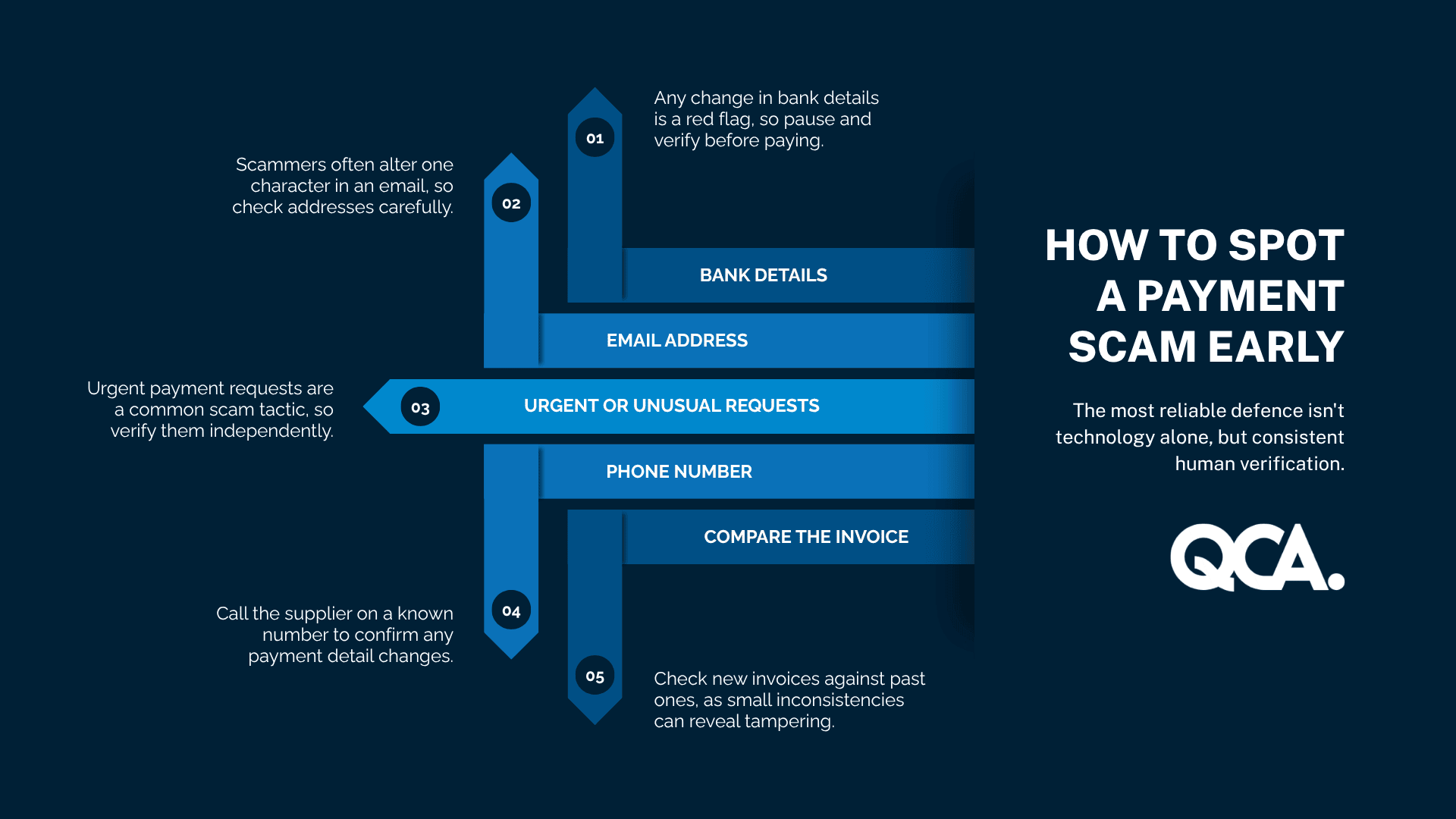
Spotting a payment scam requires deliberate habits. Scammers are skilled at making fraudulent invoices look real, so the warning signs are subtle. The most reliable defence isn’t technology alone, but consistent human verification.
Check for Unexpected Changes in Bank Details
Treat any change to a supplier’s bank details as a red flag. Scamwatch confirms that a fake invoice usually contains different payment details from the real business, even when everything else looks identical. If the BSB or account number has changed, stop and verify.
Look Closely at the Email Address
Scammers often alter a single character in an email address. Scamwatch notes that this is one of the most common tactics used in payment redirection scams. A missing letter, an added number or a different domain extension can indicate impersonation.
Be Cautious With Urgent or Unusual Requests
Scammers often create urgency to reduce scrutiny. If a supplier suddenly requests immediate payment or claims their bank details have changed due to an audit, system upgrade or compliance issue, verify the request independently.
Verify Changes by Phone Using a Trusted Number
The ACCC advises calling the business on a number you have sourced independently, not the number in the suspicious email, to confirm payment details. This single habit prevents most payment scams. If the supplier did not send the invoice, they will tell you immediately.
Compare the Invoice to a Previous One
A genuine invoice should match the formatting, language and bank details of earlier invoices. Even small inconsistencies can indicate tampering. Scamwatch recommends checking the invoice against a real business email or invoice to identify differences in payment details.
Practical Habits That Protect Your Business
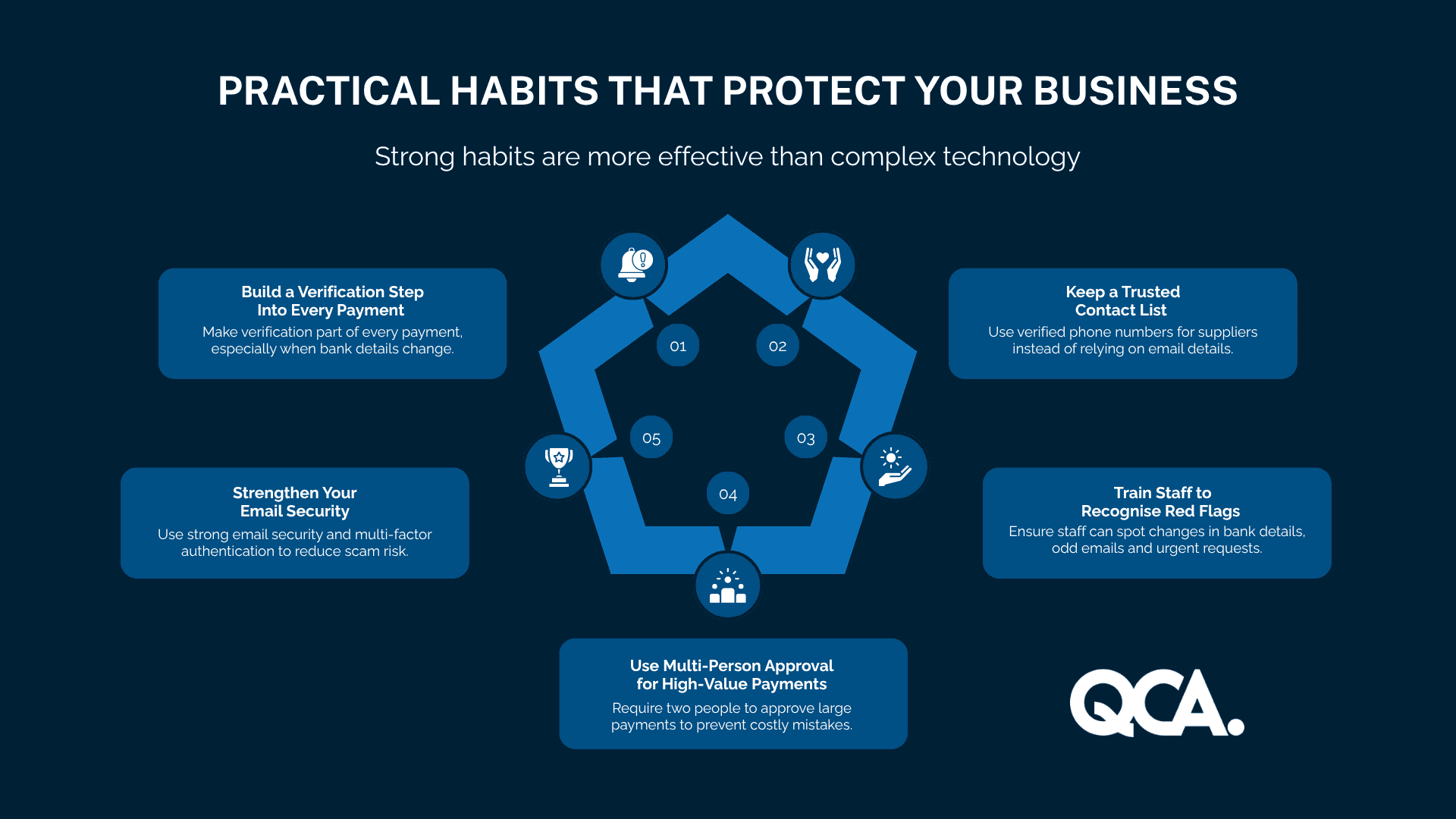
Strong habits beat complex technology. Payment scams succeed when staff assume an invoice is legitimate. They fail when staff pause and verify.
Build a Verification Step Into Every Payment
Make verification a standard part of your payment workflow. If bank details change, staff must confirm the change by phone before processing the payment. This applies to every supplier, even long-term partners.
Keep a Trusted Contact List
Maintain a list of verified phone numbers for suppliers, subcontractors and service providers. Staff should use these numbers to verify details rather than relying on contact details in an email.
Train Staff to Recognise Red Flags
Staff should know the common signs of a payment scam, including unexpected changes to bank details, unusual email addresses and urgent payment requests. Regular training reduces the risk of human error.
Use Multi-Person Approval for High-Value Payments
A second set of eyes can prevent costly mistakes. Multi-person approval ensures that no single staff member can process a high-value payment without review.
Strengthen Your Email Security
Although habits are the strongest defence, email security still matters. Use multi-factor authentication, update passwords regularly and ensure staff understand the risks of phishing emails.
How Payment Scam Prevention Links to Your Bookkeeping
Payment scam prevention aligns naturally with your bookkeeping processes. Bookkeeping is not just about recording transactions. It is about ensuring payments are accurate, authorised and legitimate. When your bookkeeping team verifies supplier details, checks invoices, and confirms payment changes, they perform essential cybersecurity functions.
For mid-sized businesses, bookkeeping and cybersecurity overlap more than most people realise. A strong bookkeeping process reduces the risk of fraudulent payments. A weak process creates openings for scammers. Integrating verification habits into your bookkeeping workflow strengthens both financial accuracy and cyber resilience.
What to Do If You Suspect a Payment Scam
If you believe you have received a fraudulent invoice, stop immediately. Do not pay the invoice. Contact the supplier using a trusted phone number and ask whether they sent the invoice. If you have already paid the invoice, contact your bank as soon as possible. Scamwatch advises that early reporting increases the chance of recovering funds, although recovery is not guaranteed.
You should also notify your internal team, review recent email activity and consider whether your email account or the supplier’s account may have been compromised. Payment scams often indicate broader vulnerabilities that need attention.
Supporting Gold Coast Businesses With Payment Scam Prevention
At QC Accountants, we help businesses strengthen their financial processes so we catch payment scams before money leaves the account. We review your payment workflows, identify verification gaps, and help you build habits that protect your business year-round. For businesses in the three to ten million turnover range, these habits are essential. They reduce financial risk, protect supplier relationships and support long-term stability. If you want guidance on strengthening your payment processes or reviewing your bookkeeping systems, book a chat or call us on (07) 5593 6060.