
The Federal Government’s plan to introduce a 30% trust tax from 1 July 2028 will reshape how Australian businesses structure their operations, distribute profits, and plan for long-term growth. For established Gold Coast businesses, particularly those in the $3-to-10 million turnover range, this reform represents a significant shift in the tax landscape. The trust tax aims to align the tax rate on discretionary trust distributions with the company tax rate. Although the final legislation has not yet been released, the direction is clear. The Government intends to reduce the flexibility of discretionary trusts and create a more consistent tax outcome across business structures.
For mid-sized businesses, this change requires a strategic response. Many business owners have relied on discretionary trusts for profit distribution, asset protection and succession planning. The introduction of the trust tax means these arrangements may no longer deliver the same benefits. Reviewing structures, modelling future scenarios and preparing for potential adjustments will be essential.
Why the Trust Tax Matters for Established Businesses
Discretionary trusts have long been a preferred structure for growing businesses. They provide flexibility in distributing profits, allow income streaming to beneficiaries and offer strong asset protection benefits. Many Gold Coast businesses use trusts as part of a broader group structure that includes operating companies, property holding entities and investment vehicles. The introduction of the trust tax changes the value proposition of these arrangements.
If trust distributions are taxed at a flat 30%, the ability to distribute income to beneficiaries at lower tax rates becomes limited. This affects business owners who rely on trust distributions to manage personal tax outcomes, support family members or reinvest profits into other ventures. For mid-sized businesses, the trust tax changes the economics of group structures. Decisions made years ago may no longer be optimal, and business owners will need to review how profits flow through their entities and whether alternative structures provide better outcomes.
What the Trust Tax Is Expected to Cover
Although the final legislation has not been released, the Government has indicated that the trust tax will apply to distributions made by discretionary trusts. The tax is expected to apply to most forms of trust income, including business profits. Distributions to adult beneficiaries will be taxed at 30% regardless of the beneficiary’s personal tax rate. The tax will operate similarly to the company tax system.
The proposal does not eliminate trusts. Instead, it changes how trust income is taxed. Trusts may still provide asset protection, succession planning and operational benefits. However, the tax advantages that have historically made trusts attractive may be reduced. For established businesses, the key issue is how the trust tax interacts with existing structures. Many business groups use trusts to hold shares in operating companies, manage property investments or distribute profits to family members. The trust tax may affect each arrangement differently.
How the Trust Tax Could Affect Business Structures
The introduction of the trust tax may lead to significant structural changes across the mid-market. Business owners will need to consider how the tax affects profit distribution strategies, group structure design, asset protection arrangements, succession planning and investment structures.
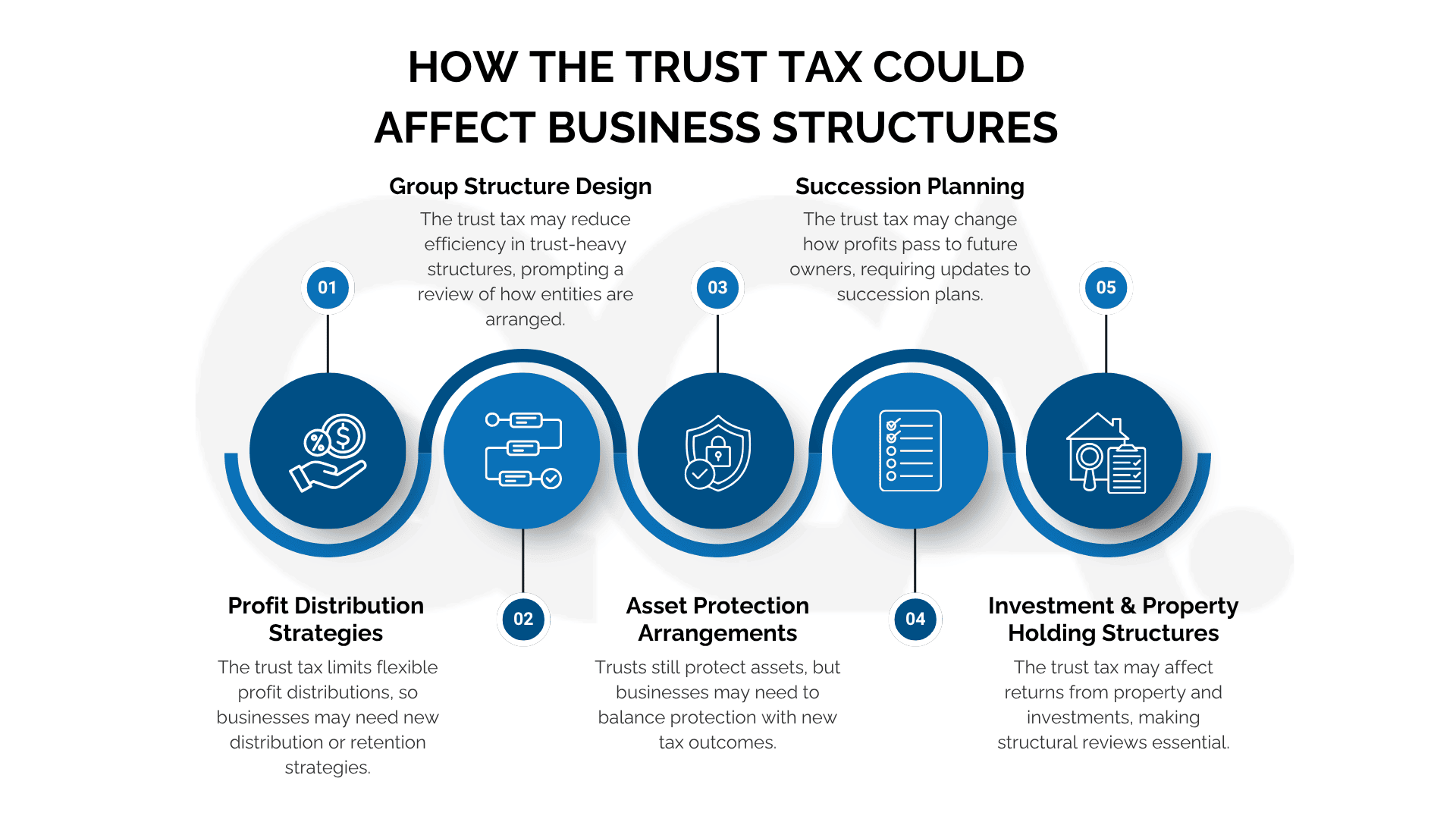
Profit Distribution Strategies
Trusts have traditionally allowed business owners to distribute profits in a tax-efficient manner. The trust tax reduces this flexibility. Business owners may need to consider alternative strategies such as retaining profits in a company or restructuring the flow of distributions. The trust tax may also influence how business owners manage personal tax outcomes and long-term wealth planning.
Group Structure Design
Many business groups use a combination of companies and trusts. The trust tax may make some structures less efficient. Business owners may need to assess whether their current structure remains optimal or whether a different arrangement provides better outcomes. This may involve reviewing how entities interact, how profits are shared and how risks are managed across the group.
Asset Protection Arrangements
Trusts provide strong asset protection benefits. The trust tax does not change this. However, business owners may need to balance asset protection with tax efficiency. In some cases, a hybrid structure may provide the best outcome. Reviewing asset protection strategies will be essential to ensure they remain effective under the new tax regime.
Succession Planning
Trusts are often used to manage succession planning. The trust tax may influence how profits are distributed to family members or future owners. Business owners may need to review their succession plans to ensure they remain effective. This may involve updating trust deeds, reviewing beneficiary arrangements and considering alternative structures for long-term ownership.
Investment and Property Holding Structures
Many businesses use trusts to hold property or investments. The trust tax may affect the tax treatment of rental income, capital gains or investment returns. Business owners may need to review whether their property holding structures remain efficient. This may involve assessing whether a company-based structure provides better outcomes for long-term investment strategies.
How Fixed Election Timing Could Influence the Trust Tax
The introduction of fixed federal election timing adds another layer of complexity. The trust tax is scheduled to commence on 1 July 2028. Depending on the timing of future elections, the policy could be confirmed, amended or delayed. Fixed election timing means governments have predictable windows to introduce major reforms. Future governments’ policy priorities, the economic environment leading into the 2028 start date, feedback from business groups, and legislative timelines may influence the trust tax.
For established businesses, this means planning must be flexible. While the trust tax is scheduled to commence in 2028, business owners should prepare for potential adjustments. Building adaptable structures now reduces the cost of future changes. Businesses that invest early in robust compliance frameworks will be better positioned to adapt to future regulatory developments.
Strategic Considerations for Mid-Sized Businesses
The trust tax requires a strategic response. Business owners should consider several key areas to ensure their structure remains effective.
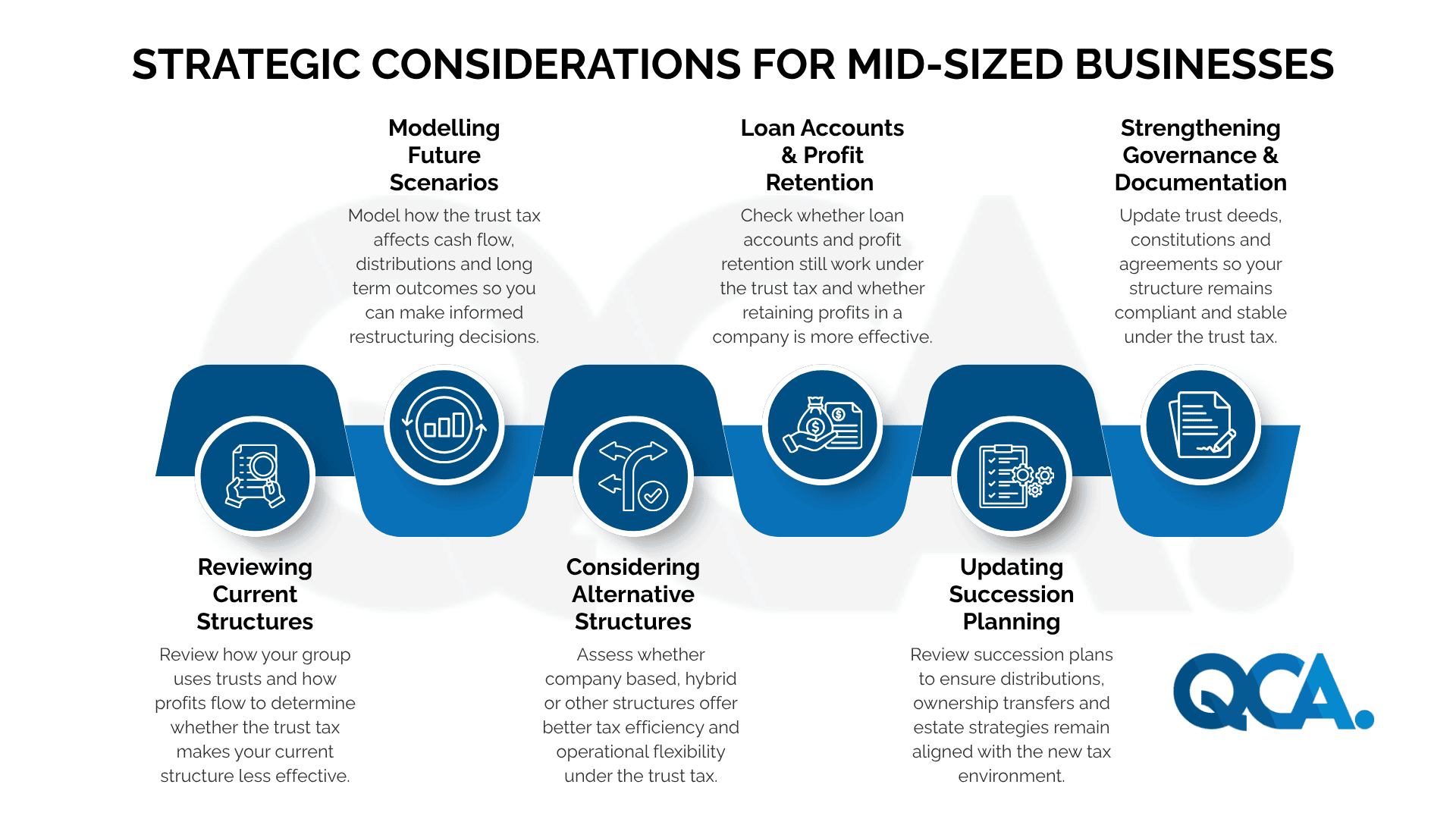
Reviewing Current Structures
The first step is to review your existing structure. Identify how your group uses trusts and how profits flow through your entities. Consider whether the trust tax affects your current arrangements and whether alternative structures provide better outcomes. This review should assess operational efficiency, tax outcomes, and long-term strategic goals.
Modelling Future Scenarios
Scenario modelling is essential. Business owners should model how the trust tax affects profit distribution strategies, personal tax outcomes, group cash flow, investment returns and succession planning. Modelling helps identify potential issues and opportunities and provides a basis for making informed decisions about restructuring. It also helps business owners understand how different structures perform under various tax scenarios.
Considering Alternative Structures
Depending on your circumstances, alternative structures may provide better outcomes. You may consider company-based structures, unit trusts, hybrid arrangements, and corporate groups with holding companies. Each option has advantages and disadvantages, and the best structure depends on your business activity, risk profile and long-term goals. Reviewing alternative structures allows business owners to identify arrangements that provide both tax efficiency and operational flexibility.
Reviewing Loan Accounts and Profit Retention Strategies
Many business groups use loan accounts to manage profit flows. The trust tax may affect how loan accounts are used. Business owners may need to consider whether retaining profits in a company provides better outcomes. Reviewing loan account arrangements ensures they remain effective under the new tax regime and supports long-term financial planning.
Updating Succession Planning
Succession planning should be reviewed to ensure it remains effective under the trust tax. Consider how the tax affects family distributions, ownership transfers, estate planning and long-term business continuity. Succession planning is a long-term process, and early review helps keep your plan aligned with your goals. Updating succession planning documents ensures they reflect the new tax environment.
Strengthening Governance and Documentation
Governance and documentation will become increasingly important. Business owners should keep their documentation up to date, including trust deeds, company constitutions, shareholder agreements, loan agreements, and distribution resolutions. Clear documentation reduces risk and ensures your structure operates effectively under the new tax regime. Strong governance supports long-term business stability and compliance.
What Gold Coast Businesses Should Do Now
Although the trust tax is several years away, preparation should begin now. Mid-sized businesses often have complex structures that require careful planning. Early action reduces risk and provides more time to implement changes. Conducting a structural review is the first step. Review your current structure to see how the trust tax affects your arrangements, and consider whether it remains optimal. Scenario planning should follow. Model how the trust tax affects your business and identify potential issues and opportunities. Use modelling to inform your decision-making.
Professional advice is essential. The trust tax is a complex reform, and working with advisors who understand the regulatory landscape helps you avoid missteps and implement practical solutions. Planning for flexibility is also important. The trust tax may evolve over time, and building structures that can adapt to future changes reduces the cost of future adjustments.
Supporting Gold Coast Businesses Through Structural Change
At QC Accountants, we help established businesses prepare for the trust tax. We review your structure, model future scenarios, and provide strategic advice to keep your business efficient and resilient. For businesses with turnover between $3-10 million, early preparation reduces risk and supports long-term growth.
If you need guidance on how the trust tax affects your business, book a chat or call us on (07) 5593 6060.
This is general information only. It is not financial or legal advice. Tax rules may change, so check current requirements with the Australian Taxation Office or speak to us before acting.